Best Cat Trees for Small Apartments: Vertical Space Without the Footprint
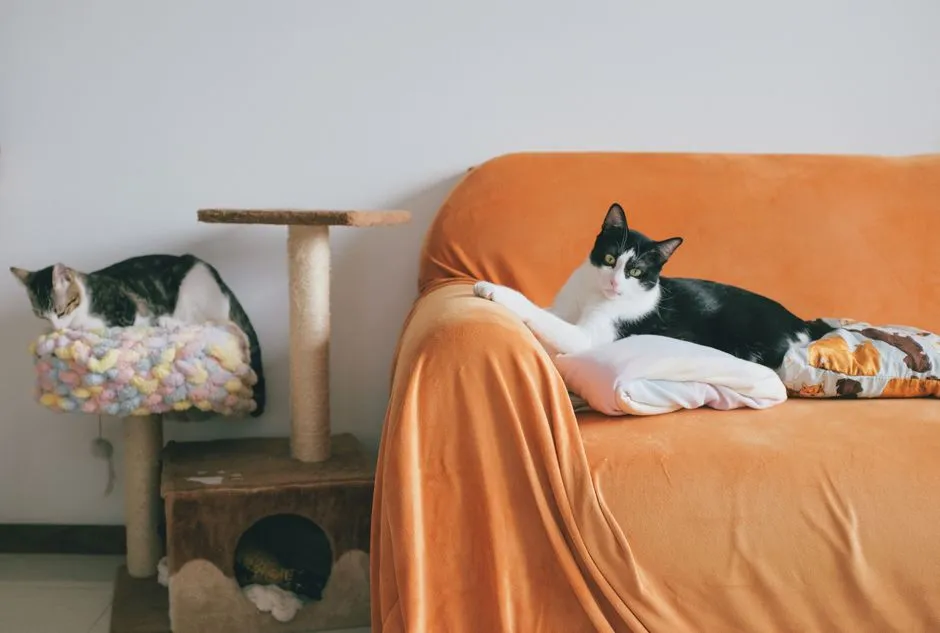
The Short Answer: Go Vertical, Not Wide
The best cat tree for a small apartment is almost never the sprawling multi-platform castle you see in pet-store aisles. It's a tall, narrow design with a footprint under roughly 24 x 24 inches — a floor-to-ceiling tension-pole tree, a slim vertical tower, or a corner unit that tucks into space you weren't using anyway. Cats measure territory in height, not square footage, so a 60-inch tower on a 20-inch base often satisfies a cat better than a wide 40-inch tree that eats half your living room.
Here's how the main small-space options stack up before we get into the details:
| Style | Typical footprint | Typical height | Best for |
|---|---|---|---|
| Floor-to-ceiling tension pole | ~18-24" square | Ceiling height (7-9 ft) | Maximum height, minimum floor space |
| Slim vertical tower | ~16-24" square | 48-70" | Renters, most cats, best all-rounder |
| Corner cat tree | ~20-26" per side | 40-60" | Reclaiming dead corner space |
| Wall-mounted shelves | Zero floor space | As high as you mount | Confident climbers, truly tiny rooms |
| Compact perch + scratcher combo | ~16-20" square | 20-36" | Kittens, seniors, studio apartments |
All of these are workable. Which one is right depends on your ceiling, your lease, and your cat's age and climbing style — so let's take them one at a time.
How We Judge Small-Space Cat Trees
Our criteria for this category are blunt, because a bad cat tree in a small apartment is worse than no cat tree — it wobbles, gets ignored, and still takes up floor space. We evaluate on:
- Stability relative to height. A tall, narrow tree lives or dies on its base weight and how the weight is distributed. One wobble during a leap and many cats write the whole tree off.
- Footprint honesty. Listed dimensions often describe the base, not the platforms that overhang it. We care about the real floor and air space the tree claims.
- Scratching surface quality. Posts wrapped in sisal rope or sisal fabric hold up to real scratching; carpet-wrapped posts mat down quickly and can teach your cat that carpet is fair game. Our cardboard vs sisal comparison covers the material trade-offs in depth.
- Perch size and placement. A top perch a cat can't fully lie down on is decoration. Look for top platforms of at least 12-14 inches across for an average adult cat.
- Assembly and disassembly. Small-apartment life often means moving. Trees that assemble with through-bolts rather than glued joints survive a second apartment.
The Picks, Style by Style
Floor-to-Ceiling Tension Pole Trees: Most Height Per Square Foot
Why it wins the category. Nothing else delivers seven-plus feet of vertical territory on a footprint the size of a bar stool. Tension-pole trees brace between floor and ceiling, which gives a slender design far more stability than its base alone could provide. For a single cat or a bonded pair in a studio, this style is usually our first suggestion: high perches for surveying the room, a full-height climbing route, and a footprint you can put beside a bookshelf.
What to check before buying. Confirm your ceiling height against the tree's stated range — most models adjust within a window (commonly somewhere in the 7.5 to 9-foot range, but it varies by model, so check). Sloped, textured popcorn, or drop-tile ceilings are poor candidates for tension mounts.
Worth knowing. Tension poles need periodic re-tightening; a pole that's loosened over months is a genuine tipping hazard for a heavy or fast-launching cat. And renters should confirm the ceiling pad won't mark paint — most leave nothing behind, but a cheap hard pad can.
Slim Vertical Towers: The Best All-Rounder
Why it's the safe pick. A freestanding tower in the 48-70 inch range with a compact square base is the pick we'd make for most people. It needs no ceiling contact, works under standard 8-foot ceilings with room to spare, and good versions combine a full-length sisal post, one or two mid perches, and a decent top platform. This is the style to choose if you're not sure — it fits almost every apartment and almost every cat.
What to check before buying. Base weight is everything. As a rule of thumb, the base should feel like the heaviest part of the box. Look for a base plate of thick particleboard or plywood rather than hollow panels, and platforms that bolt through the posts. If you can rock the assembled tree easily with one hand at the top, your cat will feel it mid-leap.
Worth knowing. Budget towers in this shape frequently skimp exactly where it matters — the base. A tower that's tall, light, and cheap is usually all three for the same reason. Expect to pay more for the boring part you can't see.
Corner Cat Trees: Reclaiming Dead Space
Why it earns a spot. Most apartments have at least one corner doing nothing. Corner trees use a triangular or quarter-round base that sits flush into it, so the tree's real cost in usable floor space is close to zero. The two adjacent walls also add a psychological (and sometimes literal) brace, and many cats like a perch with solid walls on two sides.
What to check before buying. Measure both wall lengths from the corner, and check clearance for doors, radiators, and curtains. Platforms should face into the room — a corner tree with perches angled at the wall gives your cat a view of paint.
Worth knowing. Selection in this shape is thinner than for standard towers, and some corner designs are shorter than their footprint deserves. If your corner can take a 60-inch tree, don't settle for 40 inches.
Wall-Mounted Shelves: Zero Footprint, Some Commitment
Why it makes the list. Wall shelves and mounted perches take literally no floor space, and a staggered run of three or four shelves builds a climbing route no floor-standing tree can match. For confident, athletic cats in genuinely tiny rooms, this is the ceiling-free way to go vertical.
What to check before buying. Mounting is the whole game: shelves must anchor into studs or use rated heavy-duty anchors, and each shelf should be specified for well above your cat's weight, because a landing cat applies force far beyond their standing weight. Space shelves so an average cat can step or make a short hop between them — big gaps invite falls.
Worth knowing. This is the least renter-friendly option (holes in walls) and the least forgiving of lazy installation. Also plan a route down, not just up — seniors and less agile cats need a descending path with small drops, or they'll take one big one.
Compact Perch and Scratcher Combos: The Modest Option That Still Counts
Why it belongs here. Not every cat wants altitude. Kittens, seniors with stiff joints, and naturally ground-dwelling cats often get more use from a 24-36 inch unit with a low perch, an enclosed cubby, and a solid scratching surface than from a tower they won't climb. Paired with a window perch, a small combo covers the essentials — scratch, hide, observe — in a couple of square feet.
What to check before buying. Prioritize the scratching component: a post or panel long enough for a full-body stretch (roughly the cat's body length, ideally 28 inches or more of scratchable surface for an adult). Skip units where the "post" is a stubby 12-inch column — cats scratch to stretch.
Worth knowing. A short unit doesn't replace vertical territory for a cat who wants it. If your cat already climbs your bookshelves, this is a supplement, not the solution.
Comparison: What Each Style Trades Away
| Style | Stability | Renter-friendly | Assembly effort | The trade-off |
|---|---|---|---|---|
| Tension pole | Excellent (when tight) | Mostly | Moderate | Needs compatible ceiling, periodic re-tightening |
| Slim tower | Good (base-dependent) | Yes | Low-moderate | Height capped; cheap bases wobble |
| Corner tree | Good | Yes | Low-moderate | Limited selection |
| Wall shelves | Excellent (installed right) | No | High | Wall holes, unforgiving installation |
| Compact combo | Excellent | Yes | Low | Little vertical territory |
On price: small-footprint towers and combos commonly run in the $40-$120 range, while floor-to-ceiling designs and quality wall-shelf sets tend to land higher, often $100-$250 — but prices vary widely by size, materials, and retailer, so treat those as orientation, not gospel.
Measuring Your Space Before You Buy
Five minutes with a tape measure prevents most cat-tree regret:
- Mark the footprint on the floor with painter's tape, including platform overhang, and live with it for a day.
- Check the launch zones. Cats exit a top perch onto the nearest furniture. If the perch is 55 inches up and your TV is 40 inches away, you've built a diving board.
- Measure ceiling height at the exact spot for any tension-pole design — floors and ceilings in older buildings are rarely level.
- Put it near a window if you can. A tree with a view gets used; a tree in a dark corner behind the sofa becomes a coat rack.
Getting the Tree Used, Not Just Owned
Placement and material matter more than brand. A stable tree with real sisal, by a window, in a room you actually spend time in, will earn daily use; the same tree in a hallway won't. If your cat ignores a new tree for the first week, don't panic and don't force them onto it — our guide on getting your cat to use a scratching post covers the placement and scent tricks that work just as well for trees.
And if you're weighing a tree against simpler scratching options, or want the full rundown of post heights, materials, and stability specs, start with our complete scratching post and cat tree buying guide — or browse everything in Furniture & Scratchers. Small apartment or not, the rule is the same: buy stability and height, not platform count.