Best Interactive Cat Toys for Bored Indoor Cats
- The best interactive cat-toy kit has three jobs
- Quick picks by play style
- Best overall: a wand toy you control
- Best for grab-and-rake play: a large soft kicker
- Best food-motivated solo activity: an adjustable puzzle feeder
- Best simple batting toy: an enclosed-track ball
- Electronic chasers: useful motion, more failure points
- Why lasers are not our unattended pick
- Build a rotation around the cat, not a calendar
- The 60-second safety audit
- Bottom line
- Sources checked
The best interactive cat-toy kit has three jobs
Start with a wand or rod toy for supervised chase-and-catch play, a large soft kicker for grabbing and raking, and an adjustable puzzle feeder for food-motivated activity. Add a sturdy enclosed-track ball if your cat loves batting. That small kit covers more feline behaviors than a pile of flashing gadgets whose main enrichment benefit is teaching you where the spare batteries live.
The best toy is not universal. A stalker, a batter, a kicker, and a food detective are four very different shoppers, despite all refusing to fill out the survey. Watch what your cat chooses to do, match the toy to that action, and separate supervised, observed-first, and put-away toys before buying anything.
This guide follows the AAFP/ISFM Feline Environmental Needs Guidelines. Those guidelines recommend opportunities for predatory-style play and active feeding, including wand toys, catchable toys, large soft toys, puzzle feeders, and toy rotation. They also say string and potentially ingestible components should be put away after play, and small parts and bells should not be available unsupervised.
Quick picks by play style
| Your cat usually… | Best starting category | Access rule | Important check | Typical category range* |
|---|---|---|---|---|
| Stalks and chases | Wand or rod toy | Supervised only | Secure line and lure; store after play | $5–$20 |
| Grabs and bunny-kicks | Large soft kicker | Observed first | Strong seams; no loose fill or trim | $8–$20 |
| Hunts for food | Adjustable puzzle feeder | Observed first | Easy starting level; washable; stable | $10–$40 |
| Bats objects | Enclosed-track ball | Observed first | Ball cannot escape; no trapping gaps | $8–$25 |
| Pounces on hidden motion | Under-cover chaser | Supervised trial | Guarded mechanism; secure battery door | $25–$45 |
| Fixates on light | Prefer a catchable alternative | Do not leave a laser running | Eye and reflection risk | $15–$40 |
Ranges are current category ballparks, not price quotes; sales and construction move them.
“Observed first” is not a lifetime safety certificate. It means watching full sessions until you know how this cat interacts with this toy, then inspecting it before later use. A determined cat can turn decorative felt into confetti and product assumptions into an emergency-vet invoice with impressive efficiency.
Best overall: a wand toy you control
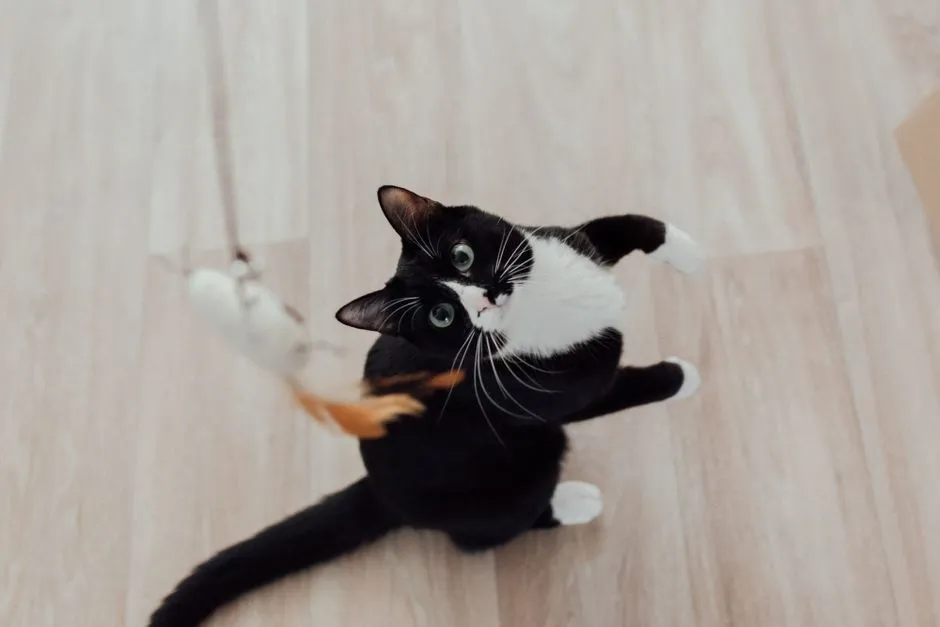
A human-driven wand is the most adaptable toy in the kit. You can make the lure travel like ground prey—low, quick, and away from the cat—or like flying prey with short swoops and pauses. The AAFP/ISFM guidelines specifically describe these movements and recommend allowing the cat to capture the lure.
Look for a comfortable handle, inspectable connections, a non-elastic cord rather than a stretchy line, and replaceable lures without bells or easily detached ornaments. A longer wand can create distance between claws and hands, but there is no magic minimum length that fits every room and handler. The correct length is one you can control without whipping the lure into faces, lamps, or the cat's water bowl.
Make the lure flee rather than repeatedly charge the cat. Pause behind furniture, change direction, and let the cat succeed. Avoid using hands or feet as prey; the feline guidelines warn against it because somebody eventually learns the wrong lesson, and it is rarely the cat.
Storage rule: the wand, cord, string, elastic, feathers, and detachable lure go into a closed cupboard after play. Inspect them before every session. If any portion appears swallowed, do not pull a visible string from the mouth or anus; contact a veterinarian promptly for instructions.
Best for grab-and-rake play: a large soft kicker
A kicker gives the front paws something to hold and the hind feet something legal to rake. The feline guidelines recommend large soft toys that can be bitten and raked, making this more than an adorable fabric baguette.
Choose a size the cat can wrap around without disappearing beneath it. Favor tight stitching, minimal exterior trim, and no glued eyes, bells, ribbons, or hard decorations. Squeeze the toy and inspect every seam before first use. Then watch how the cat treats it: a gentle grappler and a plush surgeon need different replacement schedules.
Catnip or silvervine may add interest. In a 100-cat study, roughly one in three did not respond to catnip; 22 of 31 catnip non-responders did respond to silver vine. Try one sample before buying a six-pack. Our catnip versus silvervine guide explains the choice without promising that your cat will respect botanical marketing.
Retire the kicker if seams open, stuffing escapes, fabric thins, or a scented insert becomes accessible. “Still mostly a toy” is not a useful safety category.
Best food-motivated solo activity: an adjustable puzzle feeder
Puzzle feeders make a cat manipulate an object or search a surface to access food. The AAFP/ISFM feeding consensus recommends puzzle feeders and forage feeding as ways to address natural feeding behavior. The environmental guidelines also suggest hiding food, scatter feeding appropriate dry food, and using purchased or homemade devices.
Start easier than your ego prefers. The first puzzle should let the cat discover a reward quickly; frustration is not a tutorial. Good buying features include:
- adjustable openings or removable difficulty pieces;
- a broad, stable base that does not flip onto the cat;
- openings that cannot trap the cat's jaw or paw;
- smooth, cleanable food-contact surfaces;
- no small plugs or covers the cat can remove and swallow;
- a design you can completely open for cleaning.
Food used in the puzzle belongs inside the daily feeding plan, not on top of it. Ask a veterinarian before changing how you feed a cat with a prescription diet, weight-management plan, dental pain, food guarding, diabetes, gastrointestinal disease, or mobility limitations. Our guide to slow-feeder bowls covers a related but different job.
Watch the first several uses. Confirm the cat solves rather than chews the device, does not become distressed, and can access the food without scraping the face or twisting painfully. Multi-cat homes may need separate stations so one expert does not become a tiny, furry toll collector.
Best simple batting toy: an enclosed-track ball
A ball captured inside a rigid track offers repeatable paw-driven motion without a cord or motor. It can be a useful independent option for cats that already bat bottle caps, springs, or anything else capable of migrating under an appliance.
The word captured matters. Confirm the ball cannot be pried out, the track cannot separate under normal force, and no slot narrows into a toe trap. The base should stay flat rather than skid into walls. Run a finger around all edges for burrs, cracks, or sharp molding.
Do not assume it is a kitten-only toy or that every adult will adore it. Age is less informative than play style. Observe first, then leave it available only if the structure remains intact and the cat uses it safely.
Electronic chasers: useful motion, more failure points
Under-cover wands, rolling motors, and moving targets can invite pouncing when a person is unavailable for the controls. They also introduce gears, shafts, battery doors, charging cables, fabric edges, heat, and predictable motion. That is a longer inspection list, not proof that electronic toys are bad.
Before buying, look for an enclosed mechanism, a battery compartment that cannot be pawed open, a stable base, replaceable wear parts, and clear cleaning instructions. Motors can drain batteries quickly, and claws eventually shred some fabric covers, so check whether replacement covers are sold. An automatic shutoff can preserve novelty and power; it does not make a toy safe to run while nobody is home.
Observe multiple full cycles. Stop use if the cat bites into the motor housing, catches fur or claws, pins the mechanism until it strains, removes a cover, or becomes distressed. Unplug and store charging cables away from the cat. Discard a device that cracks, swells, overheats, smells unusual, or behaves erratically, and follow local rules for battery disposal.
Manufacturer claims such as “random” or “lifelike” are descriptions, not feline peer review. The real test is whether the movement suits your cat and the hardware survives close inspection.
Why lasers are not our unattended pick
The US Food and Drug Administration includes laser cat toys among laser products of concern and warns that direct beams—and reflections from mirrors or polished metal—can injure eyes. It says never to aim a laser at a person or animal. That rules out the casual “point it near the cat and hope” approach.
We do not recommend automatic lasers for unattended play. You cannot control the beam path, reflective surfaces, a tipped device, label accuracy, or the cat's response while absent. If an adult chooses to use a laser product, examine its compliance, warning, output, and class labeling. The FDA says never aim at a person, animal, vehicle, or aircraft, and warns that metallic or reflective surfaces can redirect a hazardous beam. A catchable wand, tossed soft toy, or food puzzle is the cleaner default.
The common advice to finish a laser chase with a treat or physical toy may create a catchable ending, but it cannot remove the optical hazard. A snack is not protective eyewear. If a cat paces or vocalizes afterward, retire the laser. Cats already fixated on lights or shadows should get a catchable alternative instead.
Build a rotation around the cat, not a calendar
The feline environmental guidelines recommend rotating toys to reduce habituation and boredom. They do not prescribe one universal weekly schedule, number of toys, or session length. Your rotation should respond to the cat.
Keep a small mix of safe options available, store the rest, and reintroduce them later. Notice the first behavior that appears:
- stalking: slow wand movement or a partially hidden toy;
- chasing: a fleeing wand lure or safely tossed soft object;
- pouncing: a lure that pauses behind cover;
- grabbing and raking: a kicker;
- batting: a secure track toy;
- searching for food: an easy puzzle feeder.
Older cats still need play, but the guidelines note that type and intensity may need modification. Kittens need size-appropriate toys and feeders. Cats with pain, breathing disease, impaired vision, neurological problems, recent surgery, or mobility limits need a veterinarian-guided plan.
No toy replaces interactive time with you, and no single session length fits every cat. Two short hunts of about 10–15 minutes, morning and evening, are a practical starting rhythm; adjust to age, health, interest, and recovery. Let the cat catch the lure, then offer part of its planned food—hunt, catch, eat, groom, rest. Stop when the cat disengages, and never drive play to panting or distress. A sudden drop in play, altered movement, hiding, or a new behavior change deserves a veterinary call; boredom and illness can wear similar disguises from across the room.
The 60-second safety audit
Before each session, ask:
- Are any cords, fibers, feathers, bells, trim, or small parts loose?
- Are seams, plastic, track joints, and battery doors intact?
- Can any opening trap a toe, claw, jaw, head, or tail?
- Is the toy appropriate for this cat's size, mobility, and chewing style?
- Will a person supervise every string, laser, and moving mechanism?
- Is the floor clear of collisions, hot surfaces, and fragile objects?
If the answer is uncertain, pause the toy. Our full cat-toy safety guide goes deeper, and the rest of toys and play helps match materials and scents.
Bottom line
Build a small, behavior-matched kit: supervised wand, durable kicker, adjustable food puzzle, and—if your cat enjoys batting—a secure track. Treat electronic chasers as supervised equipment until repeated observation and inspection justify anything more. Keep lasers out of unattended play, and store all ingestible components after use.
The winner is not the toy with the most modes. It is the one that invites a natural action, survives inspection, fits the individual cat, and leaves everybody ready to play again rather than wondering where the emergency clinic is.
This article offers general product and enrichment guidance, not veterinary advice. Ask your veterinarian about sudden behavior changes, pain, feeding concerns, or play for a cat with a medical condition.