Cat Harness Guide: Fit, Leashes and First Outings
- What should you look for in a cat harness?
- First decide whether walking suits this cat
- Which cat harness style should you choose?
- How do you fit a cat harness?
- A leash belongs on the harness, not the collar
- Train indoors before you open the door
- What should a first outing look like?
- The buying checklist that matters
- When a carrier or enclosed space is the better tool
- Sources
What should you look for in a cat harness?
A good cat harness fits the individual cat, allows normal movement, and stays secure when the cat turns or backs up. Choose an adjustable cat-specific design, measure exactly as its manufacturer directs, and attach a light fixed-length leash to the harness, never to a collar. No harness is escape-proof. Train indoors first, let the cat set the pace, and ask your veterinarian about health, vaccination, and parasite-prevention needs before outdoor walks.
This is a buying and fit framework, not a hands-on product ranking. We did not test every harness on the market. Product shapes, sizing systems, and closures vary, so the label size is only a starting point.
First decide whether walking suits this cat
A harness can provide controlled outdoor access for a cat who enjoys exploring, but a walk is not a requirement for a good life. The Feline Veterinary Medical Association includes harness-and-leash outings among ways to offer controlled outdoor access. It also emphasizes meeting an indoor cat's physical and emotional needs.
Cats Protection takes a more cautious view: most cats may find a harness stressful, although some tolerate one when introduced gradually. That disagreement is useful. The question is not whether cat walking is fashionable. It is whether this cat remains comfortable, curious, and able to choose where to pause.
Good candidates approach the harness voluntarily after careful introduction, move normally while wearing it, recover quickly from ordinary outdoor sounds, and still take treats or investigate. A cat who repeatedly freezes, hides, flattens close to the ground, struggles hard to escape, or remains distressed after returning indoors is not asking for a longer route.
Ask your veterinarian before outdoor training about the cat's health and the current vaccination, identification, and parasite-prevention plan. Cats Protection also recommends current microchip details before outside access. Medical suitability belongs with the veterinarian, not an online size chart.
Which cat harness style should you choose?
The best style is the one that can be adjusted to the cat's body, stays secure during careful indoor checks, and does not rub or restrict movement. These descriptions are editorial buying distinctions, not guarantees about every product in a category.
| Style | What it is | Useful when | Check closely |
|---|---|---|---|
| H-style | Narrow straps form loops around the neck or shoulders and chest, joined along the back | The cat dislikes broad fabric and the straps offer enough adjustment | Gaps at the shoulders, twisting straps, narrow contact points, and buckle position |
| Vest or jacket | A wider panel wraps more of the chest and torso | The cat accepts more body coverage and the shape matches its proportions | Heat, bulk, rubbing behind the front legs, and whether fasteners stay fully closed |
| Figure-eight | Loops cross or connect around the front and torso | Only when the maker's fit instructions are clear and the design remains stable | Uneven tightening, shifting under leash tension, and limited independent adjustment |
More fabric does not automatically mean more security. Nor does a complicated pattern. Look at the adjustment range, seam strength, closure design, leash-ring attachment, washable care instructions, and the actual body measurements the listing requires.
Avoid claims such as “escape-proof.” A frightened cat can twist, reverse, compress its body, or exploit a small gap. Treat escape resistance as a system: correct size, correct adjustment, intact closures, indoor training, a suitable leash, and a quiet setting.
How do you fit a cat harness?
Start with the product's own measuring diagram. One brand may size around the chest behind the front legs, while another also needs a neck or shoulder measurement. Record the numbers and check them against the exact model's chart. Do not choose by weight alone, and do not assume the same size name transfers between brands.
Once the harness is on indoors, check five things:
- The straps lie flat rather than twisting or cutting into the coat.
- The cat can stand, walk, sit, and turn without a shortened stride.
- The front edge does not press on the throat when the leash is lightly lifted.
- Buckles and hook-and-loop panels close completely, with no coat trapped inside.
- The harness does not slide over a shoulder when the cat gently turns or backs up.
Follow the manufacturer's fit allowance rather than importing a universal finger rule. Coat thickness, body shape, strap width, and harness construction change what a given gap means. Recheck the fit when the cat grows, gains or loses weight, changes coat density, or has the harness removed and readjusted.
Do the first movement checks in a closed room with doors and windows secured. Keep the leash loose and stay close. Do not pull the cat backward to “prove” the harness works. If it shifts, opens, rubs, or allows a shoulder through, stop and resize or choose another design.
Inspect the harness before every use. Retire it if the leash ring is loose, stitching is separating, webbing is cut, a buckle no longer locks, or hook-and-loop material is clogged and will not close to the maker's specification.
A leash belongs on the harness, not the collar
Cats Protection and VCA Animal Hospitals both direct owners to attach the lead to a harness rather than a collar. Pressure on a collar can injure the neck, and a cat collar may release or slip off.
For outdoor identification, Cats Protection recommends a quick-release or snap-opening collar rather than an elastic or fixed buckle design. Its collar guidance uses a two-finger fit check, but that instruction applies to the collar. It is not a substitute for the harness maker's fitting directions. A breakaway collar is an identification carrier, not a leash anchor.
Choose a light, fixed-length leash that is comfortable to hold and easy to gather without looping it around a hand. VCA advises against retractable or long leads for initial training. Keep enough slack that the cat can investigate without being dragged, but not so much that the lead catches around furniture, plants, fences, or legs.
Train indoors before you open the door
The detailed training process belongs in a separate guide, but the purchase is not ready for outdoor use until the cat can wear it comfortably indoors. Cats Protection recommends gradual, positive introduction and returning to an earlier step if the cat is worried.
A simple readiness sequence is:
- Leave the harness nearby and reward voluntary investigation.
- Touch it briefly to the cat without fastening it.
- Fasten it for a short indoor session, then remove it before the cat becomes distressed.
- Let the cat walk normally while wearing it.
- Attach the leash indoors and follow with slack rather than steering.
- Practise near the exit without opening it.
Move forward only when the current step looks ordinary to the cat. Food can create a positive association, but it should not be used to coax a frightened cat through escalating distress. Never drag, chase, pin, or leave the cat unattended in the harness.
What should a first outing look like?
Choose a quiet, familiar area away from traffic and free-running dogs. A secure private garden can be easier than a public path. Check gates, gaps, plants, chemicals, sharp debris, and other animals before bringing the cat out. The harness reduces risk; it does not turn an uncontrolled place into a controlled one.
Cats Protection suggests beginning with a short outing of about five to ten minutes. Treat that as the source's cautious starting point, not a target the cat must complete. Open the door only when the cat is calm, stay close to the exit, keep the leash slack, and let the cat decide whether to sniff, sit, retreat, or return inside. Do not pull the cat toward a route.
Stop immediately if the harness shifts, a closure loosens, the leash snags, another animal approaches, or the cat struggles to escape. Move to a secure indoor place. For injury, breathing difficulty, collapse, or distress that does not settle, contact a veterinarian or emergency veterinary service promptly.
Weather and surfaces matter. Follow veterinary advice and the product instructions for temperature and exposure. Do not rely on a hand-to-pavement countdown as a medical or burn-safety test. If conditions are uncertain, keep the cat indoors.
The buying checklist that matters
Before paying, confirm:
- the maker identifies the product for cats and provides a measurement diagram;
- the cat's measurements sit inside the adjustment range rather than at an uncertain edge;
- neck, shoulder, and chest areas can be adjusted as the design requires;
- closures lock fully and cannot be opened by ordinary movement;
- the leash ring is sewn or fixed into the load-bearing structure;
- edges, seams, and buckles do not sit in the armpit or press on the throat;
- the cat can move normally without the harness rotating;
- care instructions explain washing, drying, and inspection;
- the return policy allows a clean indoor fit check;
- the included leash, if any, is a light fixed-length design suitable for close control.
You do not need the most expensive harness. You need the one whose measurements, adjustment, closures, and return terms let you verify the fit before the front door opens.
When a carrier or enclosed space is the better tool
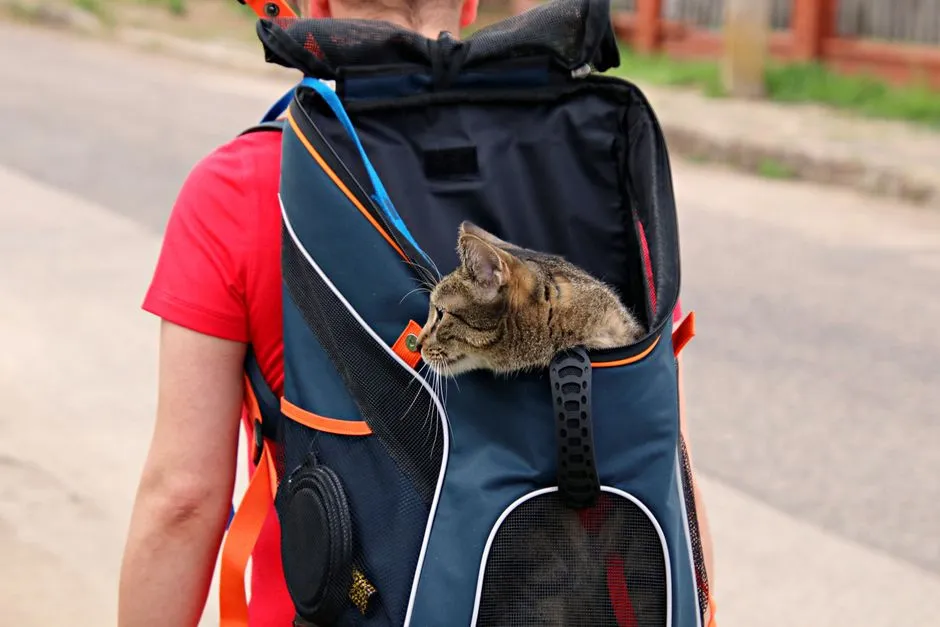
A harness is not a transport container. For a veterinarian visit or vehicle journey, use a secure carrier and follow the carrier manufacturer's directions. Our cat carrier buying guide explains the size and construction checks, while the cat backpack carrier guide covers that narrower format.
For outdoor enrichment, a catio or other secure enclosure may suit a cat who dislikes body-worn gear. Indoor climbing, hiding, scratching, foraging, and interactive play are also legitimate ways to meet behavioral needs. A cat does not fail harness training. The equipment simply did not fit that cat's comfort and safety needs.
Sources
- Feline Veterinary Medical Association, Indoor/Outdoor Lifestyle Position Statement — accessed September 3, 2026; supports controlled outdoor access, including harness-and-leash activity, alongside enriched indoor care.
- Cats Protection, “Should I walk my cat on a harness and lead?” — updated 2024 and accessed September 3, 2026; supports cautious candidate selection, gradual indoor introduction, harness rather than collar attachment, quiet locations, slack-lead handling, and short first outings.
- Cats Protection, Keeping cats safe outside — accessed September 3, 2026; supports gradual harness use, microchip identification, vaccination discussion, and quick-release collars.
- Cats Protection, Choosing a cat collar — accessed September 3, 2026; supports quick-release or snap-opening collar selection, the collar-specific two-finger fit check, and collar injury cautions.
- VCA Animal Hospitals, Train your cat to walk on a leash — accessed September 3, 2026; supports a well-fitted harness, indoor acclimation, avoiding retractable or long leashes, no dragging, short first outings, current vaccinations, and parasite prevention.