How to Choose a Cat Carrier: Hard vs Soft, Sizing and Airline Rules
The Short Version
If you want the one-paragraph answer: for most cats and most trips — and for most cats that means vet visits — a hard-sided carrier with a top-loading door is the least stressful, easiest-to-clean choice. If you fly, or you walk to the vet and need something light on your shoulder, a soft-sided carrier with a structured frame and locking zippers is the better tool. Size it so your cat can stand, turn around, and lie down — roughly one and a half times your cat's length — and check the actual interior dimensions, not the marketing photo.
Everything below explains how we got there, where each type fails, and what the airline fine print actually requires.
How We Judge Carriers
A carrier is safety equipment first and luggage second. Every recommendation on this page is weighed against the same five criteria:
- Structural strength. Can the carrier hold its shape with a panicking cat inside? Does the floor sag when carried by the handle?
- Escape security. Zipper quality, whether zippers lock or clip together, door latch design, and seam strength. A determined cat probes every gap.
- Loading ease. A reluctant cat is far easier to lower through a top opening than to push through a front door. Top access is one of the biggest quality-of-life features a carrier can have.
- Ventilation and visibility. Mesh or vents on at least three sides, with enough coverage that the interior doesn't turn stuffy in a warm car.
- Cleanability. Accidents happen, especially on the way to the vet. Wipe-clean plastic beats machine-wash-and-hope fabric.
Price gets a mention, but it's not a criterion by itself: solid hard carriers typically run about $25–$60, and good structured soft carriers about $40–$120. Prices vary widely by size and retailer, and spending more mostly buys better zippers, better padding, and airline-friendly dimensions — not more safety per se, which is why we evaluate the features directly.
Hard-Sided vs Soft-Sided: The Real Trade-Offs
This is the first fork in the road, and the honest answer is that each type wins in different situations.
Hard-sided carriers: the default for vet runs
A molded plastic carrier with a metal or heavy plastic door is the workhorse of cat transport. It protects the cat from crushing and jostling, it can't be clawed through, and when something unpleasant happens inside, you hose it out.
Why they win: rigidity, security, and cleanability. Many models split in half, which vets genuinely appreciate — a nervous cat can be examined sitting in the bottom half of its own carrier rather than being dragged out of it. Two-door models (front plus top) solve the loading problem almost entirely.
Worth knowing: hard carriers are bulky to store, awkward to carry any distance because the weight swings at the end of one handle, and the cheapest ones use flimsy door latches that can pop under pressure. Check that the door latches in at least two points, and that the two halves are joined by real fasteners rather than just clips. Hard carriers are allowed in the cabin by most major airlines, but they have to fit the published under-seat dimensions exactly — there's no compressing a rigid shell — and many models are simply too tall.
Soft-sided carriers: the traveler's pick
A fabric carrier with mesh panels and a padded shoulder strap is lighter, more comfortable for the person carrying it, and the style most frequent flyers choose — not because airlines require it (most major carriers accept hard- or soft-sided in the cabin), but because under-seat limits favor a carrier that can compress an inch or two to fit.
Why they win: portability and cabin-friendliness. A good one has a structured internal frame or stiff base board so the roof doesn't collapse onto the cat, plus zipper pulls that lock or clip together so a clever paw can't work the door open from inside.
Worth knowing: fabric absorbs accidents and odors, floors sag on cheap models, and zipper security varies wildly. A soft carrier also offers less protection in a car — for driving, any carrier should ride on the floor behind a front seat or be belted in, and if crash protection is a priority, look for carriers that have been independently crash-tested (Sleepypod is the best-known brand that publishes crash-test results). Long-haired cats can also overheat faster in a soft bag with limited mesh.
Backpacks, cardboard, and other formats
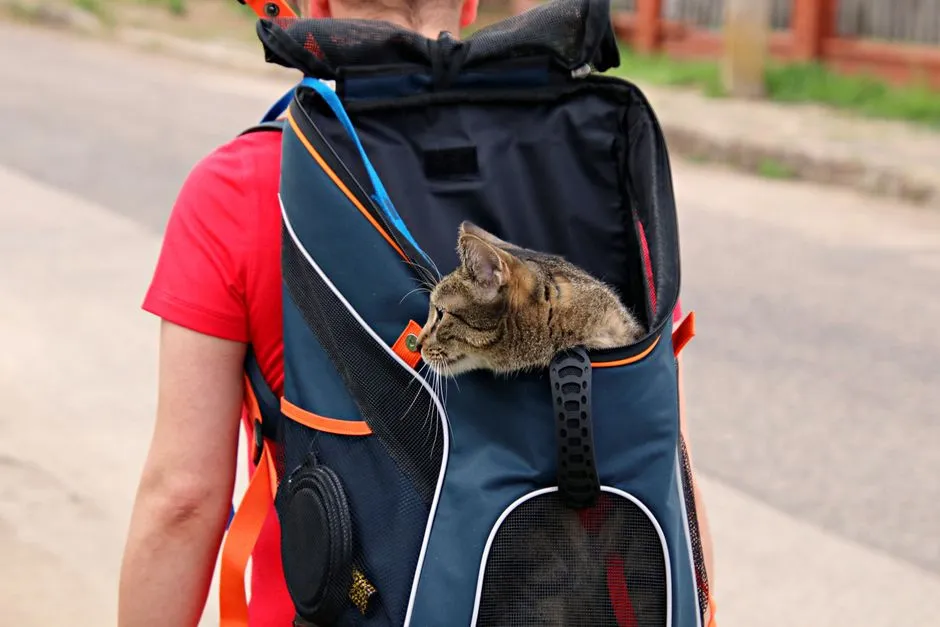
Backpack carriers are popular and divisive; some are fine for short trips, and the sealed "bubble" styles raise real ventilation concerns. They're a big enough topic that we cover them separately in our guide to cat backpack carrier safety. Cardboard carriers from shelters are a fine one-way ride home and nothing more — a motivated cat can shred one, and a scared cat urinating in one turns it structural in the worst way. Rolling carriers and wheeled cases suit only unusually calm cats; the vibration and noise unsettle most.
Quick comparison
| Feature | Hard-sided | Soft-sided | Backpack |
|---|---|---|---|
| Best for | Vet visits, car travel | Air travel, walking commutes | Short outings, calm cats |
| Escape resistance | Excellent (with good latches) | Good (with locking zippers) | Varies widely |
| Cleanability | Excellent — wipe or rinse | Fair — spot-clean or wash | Fair |
| Cabin airline use | Sometimes accepted (must fit rigid dimensions) | Widely accepted | Sometimes accepted |
| Carrying comfort | Poor over distance | Good | Best hands-free |
| Cat visibility/airflow | Moderate (vent slots) | High (mesh panels) | Varies — check ventilation |
| Storage | Bulky | Often folds flat | Moderate |
| Typical price range | ~$25–$60 | ~$40–$120 | ~$40–$100 |
Prices are broad editorial ranges; expect variation by size and retailer.
Sizing: The Part Most People Get Wrong
The instinct is to buy big — more room seems kinder. It usually isn't. Cats feel safer in a snug, den-like space, and in a moving car a too-large carrier lets the cat slide around with every turn.
The working rule: the carrier interior should be about 1.5 times your cat's length (nose to base of tail), tall enough for the cat to sit without crouching, and wide enough to turn around and lie down comfortably.
How to measure:
- Length: nose to base of tail (not tail tip), with the cat standing.
- Height: floor to top of head while sitting.
- Weight: matters for soft carriers, which list maximum loads — exceed them and the floor sags.
Then compare against the carrier's interior dimensions. Marketing photos and exterior measurements flatter every carrier; the interior is what your cat lives in. As a rough anchor, an average 10 lb adult cat does well in a carrier around 18–19 inches long; large breeds like Maine Coons often need 23–24 inches. Two cats generally mean two carriers — even bonded pairs can redirect stress onto each other in transit, and one carrier sized for two rarely fits anywhere useful.
For kittens, buy for the adult size the cat will reach and pad out the extra space with a towel in the meantime, rather than buying twice.
Airline Rules: Read the Fine Print Twice
If you're flying, the carrier stops being your choice alone — the airline gets a vote, and the votes differ.
The general shape of in-cabin rules:
- The carrier must fit fully under the seat in front of you. Under-seat space commonly falls around 17–18 inches long, 10–11 inches wide, and 9–11 inches high, but it varies by airline and by aircraft. There is no universal size.
- Soft-sided carriers get more latitude because they compress an inch or two. This is the main reason frequent flyers default to soft carriers.
- The cat must be able to stand and turn around inside — agents can and do check.
- The cat counts as your carry-on on most carriers, and there's a pet fee each way.
- Cargo is a different world. Most airlines that ship pets in cargo require rigid, ventilated crates meeting IATA container standards. Many cat owners reasonably avoid cargo entirely except for unavoidable long-haul moves; discuss risks with your vet first if it's on the table.
The practical advice: pick your airline, find its current published pet policy, and buy the carrier to those numbers — not to a carrier's "airline approved" label, which is a marketing phrase, not a certification. Brands like Sherpa and SturdiBag built their reputations on cabin-friendly flexible frames, but even those need checking against your specific airline's dimensions.
One more note: book the pet spot when you book your ticket. Airlines cap the number of animals per cabin, and the cap is small.
Features That Separate Good From Adequate
Once type and size are settled, these details decide how much you'll like the carrier in year three:
- Top-loading door. The single best convenience feature on any carrier. Lowering a cat in beats pushing a cat forward, every time.
- Locking or clip-together zippers on soft carriers. Cats learn zippers. This is the fix.
- Seat-belt loops or straps. A carrier on a car seat becomes a projectile in hard braking unless it's belted. Floor placement behind a front seat is the alternative.
- A removable, washable pad — and ideally a waterproof floor liner under it.
- Multi-point door latches on hard carriers. Single-point latches are where cheap carriers fail.
- A privacy flap or partial cover. Many cats settle faster when they can hide; a carrier that's all mesh, all the time, suits the owner's curiosity more than the cat's nerves. A light towel over part of the carrier does the same job.
Skip paying extra for wheels, built-in bowls, and expanding side pods unless you have a specific use — expansions are for airport layovers, not for the drive to the vet, and most cats ignore them.
Common Buying Mistakes
Four errors account for most carrier regret we hear about:
- Buying on looks. Stylish canvas totes with a single mesh window photograph beautifully and ventilate poorly. If the design prioritizes the person's aesthetic over airflow and structure, it's a bag, not a carrier.
- Trusting "airline approved" on the box. No airline certifies carriers. The phrase means "probably fits under many seats" — measure against your airline's actual policy instead.
- Sizing from the cat's weight alone. Two 12 lb cats can differ by four inches in length. Measure the cat, then check interior dimensions.
- Waiting until the night before. A carrier that arrives the day of travel meets a cat that has never seen it. Buy at least a couple of weeks ahead so there's time for the introduction below.
When to replace the one you have
Carriers age quietly. Retire a hard carrier when the door latch no longer clicks positively into place, when the shell fasteners crack, or when the plastic has gone brittle enough to flex under hand pressure. Retire a soft carrier when zippers separate under light pull, mesh pulls away from its seams, or the base board has softened — a sagging floor stresses cats more than most owners realize. A secondhand carrier in good condition is a reasonable buy; just scrub it thoroughly and check every latch and seam first.
Make the Carrier Boring Before You Need It
The best carrier still fails if it only appears ten minutes before a vet visit, because it becomes a one-signal object: box means needle. The fix is cheap — leave the carrier out year-round with the door open and soft bedding inside, feed the occasional treat in it, and it becomes furniture instead of a threat. If your cat already flees at the sight of it, that's trainable too; our step-by-step guide to getting a cat into a carrier without a fight covers the process, and the rest of our Carriers & Travel collection handles what happens after the zipper closes.
Bottom Line
- Mostly vet visits, travel by car: hard-sided, two-door (front + top), multi-point latches, split-shell design.
- Flying, or carrying any real distance: structured soft-sided with locking zippers and a rigid base, sized to your airline's current under-seat numbers.
- Either way: size to 1.5x your cat's length, verify interior dimensions, belt it in the car or place it on the floor, and leave it out at home so it stops being a warning sign.
A carrier is one of the few cat purchases you'll likely still own a decade from now. Buy the boring, sturdy one — your cat will never thank you, but the vet's waiting room will go a lot more smoothly.