Flying With a Cat In-Cabin: Airline Rules and Packing List
Can You Fly With a Cat in the Cabin?
Yes — most major airlines allow a cat to fly in the cabin with you, provided it rides in an airline-compliant carrier that fits under the seat in front of you and stays there for the whole flight. You'll pay a pet-in-cabin fee (commonly in the $100–$150 range each way on US carriers, though it varies), reserve the pet spot in advance because cabins cap the number of animals per flight, and your cat must be able to stand up and turn around inside the carrier — the standard wording in most published pet policies is that the animal can stand up, turn around and lie down in a natural position.
That's the short version. The long version — the one that decides whether your trip is a calm few hours or a yowling ordeal — is about picking the right carrier, booking correctly, and packing for the realistic problems: security screening, a delayed departure, and a cat who decides boarding time is the right moment to need a litter box. This guide walks through all of it in order.
One thing up front: if your cat is very young, elderly, flat-faced (Persians and similar breeds can struggle with stress breathing), or has any heart or respiratory condition, talk to your vet before booking anything. Airlines defer to health reality, and so should you.
Airline Rules That Apply Almost Everywhere
Every airline writes its own pet policy, and the details genuinely differ — so treat this as the common core, then verify your specific airline's current policy page before booking.
- The carrier must fit fully under the seat in front of you. This is the rule everything else hangs on, and it's why airlines publish maximum carrier dimensions.
- Your cat must be able to stand up and turn around in the carrier. Nearly every major carrier's policy uses some version of "stand up, turn around and lie down in a natural position." A carrier your cat can only lie down in does not meet the standard, however cozy it looks.
- The carrier counts as your carry-on. On most airlines, a pet carrier replaces either your carry-on bag or your personal item. Plan your own packing around losing that slot.
- One pet per passenger is the norm. Some airlines allow two small cats from the same household in one carrier under specific conditions, but that's the exception — confirm directly.
- Cabins have a pet quota. Airlines typically allow only a handful of in-cabin pets per flight, first come, first served. Book the pet spot the same day you book your own seat.
- Your cat stays in the carrier, gate to gate. No laps, no peeking heads at cruising altitude. Flight attendants will ask you to zip it back up.
- Age minimums apply. Airlines generally require kittens to be at least eight weeks old for domestic travel, and many set the bar higher.
- Seat restrictions exist. Bulkhead and exit rows have no under-seat space, so pet passengers can't sit there. Pick a standard economy seat.
- Paperwork varies. Many domestic US flights don't require a health certificate, but some airlines and destinations do — and international travel almost always requires vaccination records, often a microchip, and vet-issued paperwork with strict timing windows. Start international paperwork months out, not weeks.
The step nobody should skip: re-check your airline's pet policy shortly before you fly. Fees change, limits change, and an aircraft swap can change under-seat dimensions.
Under-Seat Carrier Dimensions: Getting the Fit Right
The single most common mistake is buying a carrier that meets one airline's published limit and assuming it's universal. It isn't. Each airline sets its own maximum dimensions, and the real constraint — the actual space under the seat — varies by aircraft type and even by seat position on the same plane. There is no industry-wide number to shop against.
For rough orientation only: published soft-sided maximums often land somewhere in the mid-to-high teens for length and around ten inches for width, with height limits that are the tightest and most variable of the three. Some carriers publish under-seat heights well below nine inches; others allow noticeably more width than a typical "airline size" listing assumes. Treat any range you read — including this one — as shopping context, never as a compliance check. The only numbers that count are the ones on your airline's current policy page for your aircraft and route.
A note on "airline approved" labels: there is no universal certification behind that phrase. It's marketing shorthand for "sized like most airline limits." The only approval that matters is your airline's own published policy.
The practical method:
- Look up your airline's current maximums for soft-sided carriers, for the specific route and aircraft if the policy lists them.
- Measure your carrier yourself, external dimensions, bulging pockets included. Product listings and tape measures sometimes disagree.
- Size for the cat, then check the limit. Your cat should be able to stand up fully and turn around inside the carrier. Standing height is usually the deciding dimension, because under-seat height caps are the tightest of the three — measure your cat from floor to shoulder while standing and compare that against the carrier's usable interior height, not its outside height. If the carrier that lets your cat stand comfortably is taller than your airline allows, that's a real conflict, and a large or long-bodied cat may simply not qualify for in-cabin travel. Better to know before you book than at the gate.
Carrier styles compared for cabin travel
| Carrier style | Under-seat fit | Comfort on long flights | Best use |
|---|---|---|---|
| Soft-sided, structured | Best — flexes an inch or two to fit | Good, if sized correctly | The default choice for flying |
| Hard-sided | Rigid — fits or it doesn't | Fine, but heavy through terminals | Car trips, vet runs, mesh-chewers |
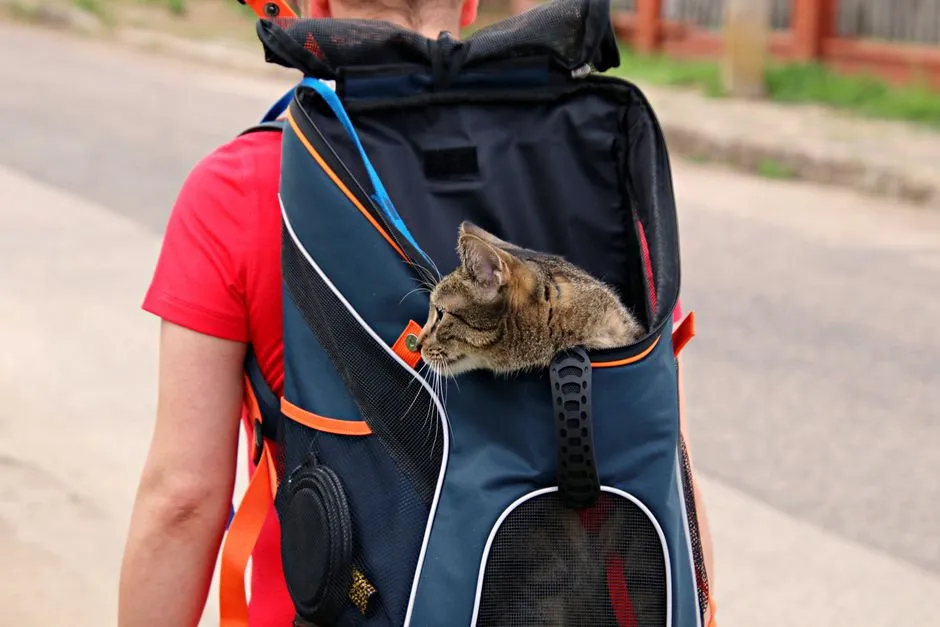
| Backpack style | Risky — rigid bubble or dome tops often push total height past under-seat caps; flat-topped models fare better | Often cramped for adult cats | Short trips; measure the dome and verify first |
| Expandable soft-sided | Good closed; expansion for layovers only | Better during long airport waits | Trips with long connections |
Why soft-sided wins: a soft carrier with a slightly flexible frame compresses to slide under a low seat, while a hard case either fits or it doesn't. The trade-off is that soft carriers depend entirely on zipper quality — a determined cat can nose open a cheap zipper, which is a genuine escape risk in a terminal. Look for locking or clip-secured zipper pulls, mesh ventilation on at least two sides, a structured top that won't sag onto the cat, and an interior tether clip for a harness. Our full cat carrier buying guide goes deeper on materials, sizing, and build quality.
On backpack carriers: some are cabin-legal on paper, but many — especially rigid bubble styles — run small on ventilation and interior room for flight-length confinement. Read our assessment of backpack carrier safety before choosing one for a flight; for anything longer than a short hop, a classic soft duffel-style carrier is usually the kinder pick.
Step by Step: From Booking to the Airport
1. Book the pet spot when you book your seat. Call the airline or add the pet during online booking. Confirm the fee, the size limit, and any paperwork for your route.
2. See your vet one to two weeks out. Confirm your cat is fit to fly, collect any required documents, and ask about calming options. Vets generally discourage heavy sedation for flying cats — sedatives can affect breathing and balance at altitude — and many airlines discourage or refuse sedated pets. Vet-prescribed anti-anxiety medication is a different conversation; if you go that route, do a trial dose at home first, never for the first time at the airport.
3. Train the carrier for at least two weeks. A cat who only sees the carrier on vet day treats it as a trap. Leave it out as furniture, feed meals near and then inside it, build up to closed-door sessions and short car rides. If your cat currently fights the carrier, start with our guide to getting a cat into a carrier without a fight — the airport is the worst place to improvise this.
4. Plan food and water timing. Most cats travel better on a light stomach — a small meal a few hours before departure is a common vet recommendation, but confirm timing for your cat. Water stays available until you leave for the airport.
5. Fit a harness under everything. At security, the carrier goes through the X-ray belt and your cat goes through the metal detector in your arms. A fitted harness with a leash is your insurance against the nightmare scenario: a spooked cat bolting loose in a terminal. You can request a private screening room instead — worth doing with a nervous cat. One collar note: if your cat wears one, make sure it's a breakaway style with an ID tag; a plain-buckle collar can snag on carrier mesh, and a collar is not a restraint anyway. The harness does that job.
What to Pack: The In-Cabin Flight Kit
Everything below fits in a small tote or your remaining personal-item space.
| Item | Why it earns its space |
|---|---|
| Harness + leash (worn, fitted) | Security screening and any out-of-carrier moment |
| Disposable pee pads, cut to carrier size (2–3) | Accidents happen; swap the liner, not the trip |
| Zip-top bags | Contain a soiled pad and its smell in seconds |
| Unscented wipes | For the carrier, the cat, and you |
| Collapsible bowl + small water bottle | Offer water during layovers, not mid-turbulence |
| Small bag of their regular food | Delays run long; unfamiliar food adds risk |
| A worn t-shirt or their usual blanket | Familiar smell is one of the cheapest calming aids available |
| A few high-value treats | Reward calm; useful at security |
| Printed vet records and required paperwork | Phones die; gate agents want paper fast |
| Recent photo of your cat on your phone | In the worst case, you need it immediately |
| Foldable litter tray + small bag of litter | For long connections only; most cats hold it on direct flights |
Optional but often useful: feline pheromone spray, applied to the carrier pad 10–15 minutes before loading the cat (never sprayed on the cat). Some cats respond to it; the evidence is mixed, so don't count on it as your only plan.
What to skip: any toy with strings, elastic, or small parts that could be chewed loose unsupervised — in a closed carrier that's a swallowing hazard, not entertainment. A soft toy that smells like home is plenty.
Travel Day and the Flight Itself
- Security: harness gripped, leash clipped, cat unloaded last and re-loaded first. Ask about a private screening room before you unzip anything.
- Gate: keep the carrier zipped, on your lap or at your feet, away from dogs. There's no prize for boarding early and sitting longer.
- In flight: carrier under the seat, ventilation panel toward you, fully closed. Drape a light cloth over part of the top if your cat settles better in dim light — never blocking all airflow. Then mostly leave them alone; constant unzipping and checking reads as instability. Slip fingers against the mesh, talk quietly, and let the engine white noise work. Many cats grumble through taxi and takeoff, then doze.
- What not to do: open the carrier to soothe a crying cat. A loose cat in a cabin is a genuine safety incident and violates every airline's rules. Ride it out; it usually subsides.
- Layovers of several hours: find a family restroom, close the door fully, leash on before the zipper opens, then offer water and the travel litter tray.
- Arrival: the carrier stays closed until you're in a fully enclosed space. A car with closed doors counts. An airport curb does not.
Flying with a cat in-cabin is mostly a logistics exercise: right carrier, early booking, honest measurements, a small kit, and a few weeks of unhurried practice. Do those five things and the flight itself is usually the easy part — a few hours of grumbling, then a nap against a t-shirt that smells like you. For gear beyond flight day, browse the rest of our carriers and travel guides.